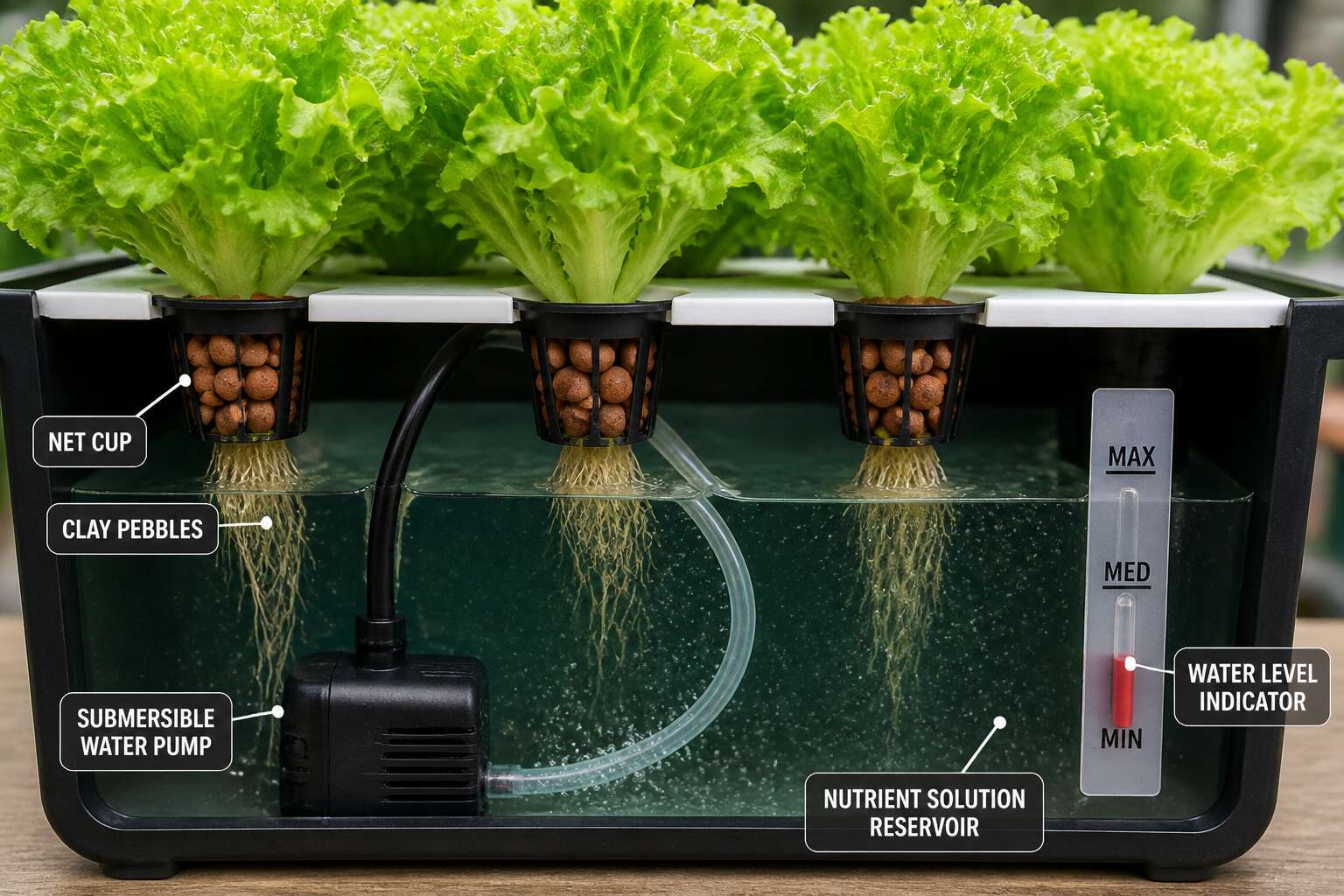
The Core Structural Framework of Your Setup
Growing Trays and Channels
A single growing tray can support dozens of plants in the space of a small table. That density makes these hydroponic system parts the first decision in any build. In South Africa, where municipal water restrictions are common, the tray and channel layout directly affects how much solution you recirculate.
Trays function as shallow reservoirs. Channels act as conduits, directing nutrient flow along a measured slope. Food grade plastic remains the standard choice, resisting UV damage and chemical leaching. Aluminium conducts heat, which can stress roots in summer. Stainless steel is heavier and costlier, but it lasts decades.
When I select these components, I weigh a few factors:
- Channel width relative to mature root spread
- Drainage angle for steady flow without stagnation
- Compatibility with existing pumps and fittings
The arrangement also governs light exposure and maintenance access. Modular channels allow expansion; fixed trays offer rigidity. Both have merit, but the final choice shapes your entire hydroponic system parts list. Consider how much water a single well angled tray can save per cycle!
Reservoir Tanks and Their Sizing
A 1000 litre reservoir weighs a tonne before you add a single plant. That weight settles on your floor, your pump, and your municipal water bill! Reservoir tanks are the core structural framework of any hydroponic system parts list, and their sizing dictates pump load and nutrient concentration.
In South Africa, where municipal water restrictions are common, the reservoir volume determines how long the system can run without a top-up. The right size depends on factors like:
- Total plant count and expected water uptake per day
- Evaporative loss from the grow space
- Pump flow rate and irrigation cycles
The remaining hydroponic system parts depend on this volume, and the figures shift with the seasons. A winter reservoir may suffice at 20 litres per plant, but summer transpiration can double that demand. A buffer of 30 percent is common in local builds to keep roots submerged during load shedding.
Support and Frame Structures
Most growers never measure the load their frame carries. In South Africa, we build against gusty Highveld winds and uneven concrete floors. A poorly anchored support structure transfers vibration to the growing trays, disturbing root zones and accelerating nutrient stratification.
Every kilogram of water, biomass, and equipment passes through this framework. Material choice matters. Galvanised steel resists rust in high humidity. Aluminium offers lighter weight at a higher cost. Pine timber may seem economical, but moisture causes warping and rot within two growing cycles.
- Load rating per square metre
- Corrosion resistance in humid grow rooms
- Adjustable feet for uneven floors
- Access for servicing pumps and valves
These factors determine whether your hydroponic system parts maintain alignment under continuous load.
Water Circulation and Nutrient Delivery Systems
Submersible and Inline Water Pumps
Hydroponic yields rely more on water movement than on nutrient strength. A pump that cycles the full reservoir volume each hour keeps oxygen levels stable and roots active. Submersible pumps rest inside the tank, quiet and cooled by the solution around them. Inline pumps sit outside, which makes them easier to inspect and swap without draining the reservoir.
Both styles have a place in a balanced layout. For vertical towers or long benches, an inline unit with a higher head height is the right choice. For simple tray systems, I find a small submersible pump offers a clean install. These hydroponic system parts must be sized to your delivery line, because a pump that pushes too hard can damage delicate roots.
When you compare pumps, look at three numbers:
- Head height, in metres, from the water surface to the highest outlet.
- Flow rate, in litres per hour, matched to your number of trays.
- Wattage, which shows up on your electricity bill.
Select a unit with an adjustable flow valve, and confirm it can run continuously!
Tubing, Hoses, and Connectors
The tubing moves nutrients from reservoir to root zone. One millimetre of internal diameter difference can change delivery rates by a third. I have seen clean builds fail because a hose kinked behind a support frame. PVC and silicone are the two materials worth considering. PVC stays rigid and handles pressure well. Silicone remains flexible and tolerates repeated bending. These hydroponic system parts need matching sizes. A 13 mm tube fits a 13 mm barb, forcing a seal. Mismatched parts leak and introduce air into the line.
For connectors, quick-release fittings save time during reservoir changes. Barbed adapters work for permanent joints. Consider the path from pump to tray:
- Run the delivery line with a gentle upward slope.
- Place the return line at a downward angle.
- Keep both lines as short as possible.
Emitters, Drippers, and Spray Heads
Every plant receives the same flow from the emitter, which sounds fair until you realise hydroponics ignores that one plant always demands more. Emitters and drippers regulate delivery to the root zone, typically between 2 and 8 litres per hour. Spray heads mist a broader area, which suits propagation chambers.
These hydroponic system parts clog without warning. Sediment, algae, or a single grain of salt can turn a drip into a trickle. I recommend filtering at the pump. Check pressure drop along the line. Position emitters away from the stem, but not so far that roots stay dry.
- Pressure compensating emitters maintain steady flow despite pressure changes.
- Button drippers offer simple, low cost delivery for pots.
- Misting spray heads cover seeds or cuttings with fine droplets.
Return Lines and Drainage Fittings
A single blocked return line can flood a growing tray and starve roots in minutes. Drainage fittings manage the transition from channel to pipe, and their shape determines whether spent solution flows freely or pools around the crown.
A slope of 1 to 2 percent prevents pooling. Smooth interiors reduce friction and salt buildup. Use a union joint where you need to disconnect for cleaning.
- PVC or polypropylene pipe for durability
- Bulkhead fittings to seal tank entries
- Flexible hose for tight bends
These hydroponic system parts rarely get attention until a leak appears. Inspect seals monthly and keep the path unobstructed.
Environmental Control and Lighting Hardware
Ventilation Fans and Air Movement
The air within a hydroponic system is as vital as the water itself. In South Africa, summer heat can overwhelm an indoor grow room, and ventilation fans regulate the climate. I have seen thriving setups fail when stagnant air choked the roots. Proper air movement controls temperature and humidity, ensuring each plant breathes without stress. Among hydroponic system parts, airflow hardware often gets ignored. Consider these key items:
- Inline duct fans to pull hot air outside
- Oscillating fans to circulate air between tiers
- Carbon filters to purify exhaust
Without these components, the environment turns hostile. A dedicated cooling system, paired with strategic fan placement, prevents mold and strengthens stems. I always remind growers that the steady hum of a good fan signals success, not a nuisance. Invest in quality ventilation hardware; your plants will reward you with vigorous growth.
Heaters, Chillers, and Temperature Regulation
In a land where midday heat can climb beyond forty degrees, thermal stability becomes a silent partner in plant health. Heaters, chillers, and thermostatic controllers are hydroponic system parts that often receive less attention than pumps or trays, yet they dictate whether roots absorb nutrients efficiently.
A temperature swing of just a few degrees can trigger metabolic stress in leafy greens. Water chillers become essential in summer months, especially in closed-loop systems where pumps generate their own heat. Conversely, aquarium-style heaters keep winter night temperatures from stalling growth.
I once watched a grower lose an entire lettuce batch because the nutrient solution hit thirty degrees. The roots suffocated quietly. Monitoring hardware, such as inline thermostats, offers precise regulation, but only when paired with correctly sized equipment.
Humidity Management Devices
The air in your grow room lies through the numbers. A relative humidity reading of 60 percent feels safe, but the vapour pressure deficit says otherwise. In South Africa, coastal growers face muggy evenings while Highveld setups dry out by noon.
Environmental control hardware closes this gap. Controllers with capacitive sensors read moisture, temperature, and light intensity together. They trigger dehumidifiers or pressurised misting lines automatically. LED fixtures with dimmable drivers keep photon output steady without overheating the canopy.
- Capacitive humidity sensors
- Pressurised misting nozzles
- Environmental controller relays
These hydroponic system parts manage the invisible conditions that roots and leaves respond to. Neglect them, and transpiration stalls or pathogens emerge. The hardware does the watching so plants stay on schedule.
CO2 Enrichment Equipment
A sealed grow room on the Highveld can see carbon dioxide levels fall below 300 ppm by midday, long before plants approach their photosynthetic saturation point. This makes CO2 enrichment hardware one of the more valuable hydroponic system parts you will install.
Burner units convert propane or natural gas into CO2, while compressed cylinders deliver pure gas through precision regulators. Both options require a controller that reads ambient CO2 and triggers dosing only when ventilation fans are off, preventing wasted gas.
- Infrared gas sensors for accurate ppm readings
- Solenoid valves that open and close on controller commands
- Distribution tubing to disperse CO2 evenly across the canopy
In South Africa, summer heat often forces growers to vent frequently, which makes enrichment a timing challenge. CO2 release synchronised with closed ventilation windows maintains high levels without pushing electricity bills up.
Nutrient and pH Management Equipment
EC and TDS Meters
One miscalibrated probe can shift an entire crop’s trajectory. Electrical conductivity (EC) and total dissolved solids (TDS) meters translate invisible salt concentrations into actionable numbers. They are small, but they are foundational hydroponic system parts.
These meters do different work. EC meters measure the solution’s ability to conduct current, reflecting overall nutrient strength. TDS meters estimate dissolved solids in parts per million, a conversion that varies by scale. Some growers prioritize one over the other, yet both serve the same purpose: keeping fertility within a tolerable range.
Consider what a meter can reveal:
- Drifting nutrient strength after top-offs
- Inconsistent mixing from concentrated stock solutions
- Premature depletion in high-light periods
Regular checks with a reliable meter prevent the guesswork that leads to leaf burn or deficiency. In a closed system, the probe’s reading is your primary source of information about the water column.
pH Meters and Calibration Solutions
Most growers check temperature and nutrient strength daily, but pH can slip silently. A pH meter is only as truthful as its last calibration. Calibration solutions, the buffers that ground the probe, are as vital as the meter itself. In my own setup, a neglected probe shifted from 6.2 to 5.4 in three days. That drift locked out calcium! These are the hydroponic system parts that prevent such guesswork.
Regular calibration with fresh solution keeps the reading honest. Buffers of 4.0 and 7.0 are standard, but some systems benefit from a 10.01 reference. The probe’s storage and cleaning also affect longevity. A trusted routine, a sealed bottle, and a stable temperature make all the difference.
Nutrient Dosing Pumps
Precision in nutrient delivery determines crop consistency. A nutrient dosing pump releases concentrated stock solutions at measured intervals. These hydroponic system parts remove the daily chore of manual mixing, which is where most imbalances begin.
Some pumps operate on timers, others on EC feedback loops. The latter adjust automatically when readings drift, a feature worth having in high summer. Consider the following before purchase:
- Flow rate accuracy at low volumes
- Compatibility with your stock solution viscosity
- Number of dosing heads for separate reservoirs
I have seen a simple peristaltic pump outlast two expensive solenoid models. Routine inspection of tubes and seals remains essential.
Mixing and Storage Containers
Mixing nutrients is where careful growers become lazy. The difference between a bountiful harvest and a mysterious deficiency often comes down to what happens before solution touches the roots. Storage containers are where good nutrient plans survive or fail, and such hydroponic system parts often take the heaviest abuse.
Consider the mixing barrel. While we obsess over dosing pumps, the reserve tank and its agitation system determine whether that precision actually translates to plant health. Overlooking these hydroponic system parts leads to stratification, where nutrient concentrations vary dramatically between the top and bottom of the reservoir.
A few elements deserve your attention before you settle on a setup:
- Agitation method: Submersible pumps prevent sediment settling.
- Opaque walls: Algae thrives in translucent plastic.
- Sealed lids: Dust alters readings.
Your mixing vessel must also hold enough volume. A 10% buffer above total system capacity prevents overflow during aeration.
Monitoring, Automation, and Maintenance Accessories
Digital Timers and Smart Controllers
When load shedding tests your patience, a reliable digital timer secures your entire feeding schedule. These small hydroponic system parts dictate the timing of nutrient cycles and lighting, preventing the chaos that follows a power flicker. I always pair them with a surge protector to shield the delicate circuitry. Smart controllers take this a step further by reading environmental data and adjusting pumps or vents automatically. They are the difference between tending a garden and managing a system.
For consistent performance, incorporate these maintenance accessories:
- Replacement probes for pH and EC sensors
- Relay modules for high-voltage equipment
- Backup battery units for critical timers
Regular calibration of these devices ensures the data your controller receives stays accurate. Without that diligence, even a premium smart controller becomes unreliable. Quality hydroponic system parts here are non-negotiable.
Wireless Sensors and Alerts
Wireless sensors and alerts turn a silent garden into a whispering one. I rely on them to catch small disturbances before they spiral. A sudden temperature climb or a pH drift across the night becomes a signal sent to my phone. These hydroponic system parts work quietly, but they demand attention!
Thresholds matter for every critical parameter:
- Nutrient solution temperature above 26°C
- Water level dropping below the pump intake
- EC swinging more than 0.2 from target
Each notification saves a possible crop failure. Placement decides their usefulness. Put sensors away from direct light and air currents. Pair them with backup batteries because load shedding does not announce itself. Without these guards, you lose awareness even with premium controllers.
Backup Power Supplies
Load shedding does not care about your nutrient film. When the grid drops, your hydroponic system parts stop working unless you plan for it. Automation loses its mind without a clean power source. I keep a deep-cycle battery and inverter to run the water pump, air pump, and controller immediately.
Backup power supplies for these hydroponic system parts should cover at least:
- Submersible pump for nutrient delivery
- Air pump for dissolved oxygen
- Controller base station to log data
Check the battery voltage weekly. A small solar panel can extend runtime, but test under load. Batteries degrade quickly in heat, so inspect terminals monthly. Without this layer, a two hour outage becomes a crop failure.
Cleaning Kits and Replacement Parts
Drift is a silent killer. A system that looks fine on the dashboard can be quietly failing inside the pipes. Monitoring your hydroponic system parts demands more than a glance at the controller. You need physical checks, weekly swabs, and a willingness to touch things that smell vaguely of fertilizer.
Automation does not forgive negligence. A smart dosing pump still relies on clean tubing and unclogged valves. Probe wipes, soft brushes, and calibration fluid are not optional extras. They are the actual tools that keep your readings honest. I treat maintenance accessories as consumables, not investments. Replace them on a schedule, not when the system starts shouting.
Useful items for a cleaning kit include:
- Spare o-rings and gaskets for every removable joint
- Pipe brushes sized for your return lines
- Cotton swabs for sensor membranes
- Food-safe descaler for mineral buildup
- Replacement pump impellers
Stocking replacement parts for your hydroponic system parts is boring until the moment it saves your harvest. A worn seal costs a few rand. A flooded grow room costs a fortune. Keep spares for the components that actually move water and air. That is the unglamorous foundation of every automated setup.
Net Pots and Growing Media
A net pot full of salt crust lies to every sensor above it. Monitoring starts when you lift the pot and feel the weight. Automation handles the water cycles, but no controller can see inside a mesh basket. These are the hydroponic system parts that everyone skips.
That is why maintenance accessories deserve shelf space next to the spare pumps. A pot grabber, a spray bottle, and sharp scissors for root trimming cost a few rand. Keep them close. I have wasted more on replacement probes than on any of these tools. Every part, from the clay pebble to the net pot, influences the readings on your screen.
Consider your growing media:
- Clay pebbles drain fast and hold oxygen.
- Coco coir holds water and buffers nutrient solution.
- Perlite adds pore space but floats upward over time.
Automation saves time, but the medium decides how much time you actually save. These hydroponic system parts dictate how often your timer fires.
Filtration and Aeration Accessories
The cheapest probe in your nutrient tank costs more than every tool you actually need. Monitoring is the habit of proving what the controller assumes is true. A controller reads electrical signals. It cannot feel a slimy pump intake or smell a degrading pipe.
Automation puts the system on a schedule. Monitoring verifies that the schedule still applies to the physical world. These two functions never overlap. When they drift apart, your yields pay for the gap.
Maintenance accessories quietly protect every other part of the setup.
– A pot grabber lifts net pots without disturbing the root zone.
– Sharp scissors remove dead roots before they rot and spike bacteria.
– A spray bottle rinses salt deposits from sensor tips before calibration.
Filtration accessories remove what you cannot see. Sediment filters stop fine particles from scoring pump impellers. Inline strainers catch debris before it clogs an emitter. Aeration accessories replace oxygen that warm water cannot hold. Airstones distribute fine bubbles across the root mass. These hydroponic system parts extend the interval between failures. The mechanical side stays invisible when it works well. It becomes the problem when it does not.

0 Comments