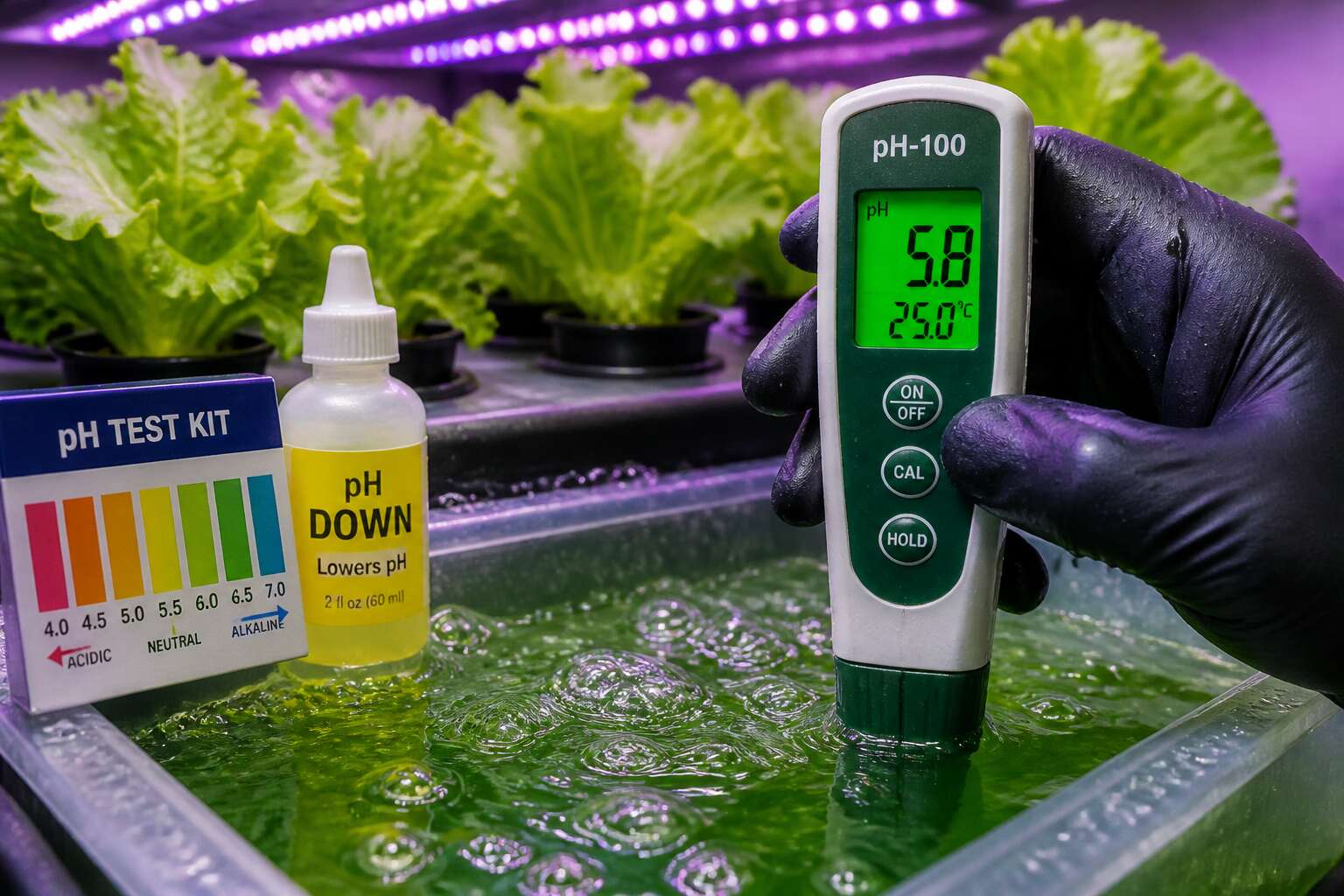
Understanding pH in Hydroponic Systems
Why pH Matters for Nutrient Uptake
A nutrient solution at pH 8.0 renders phosphorus, nitrogen, and magnesium unavailable to a tomato plant. The pH scale, measuring hydrogen ion activity, dictates whether roots can access essential elements. A reading of 5.5 to 6.3 keeps iron and manganese soluble, while drifting outside that range locks out nutrients entirely!
The relationship between pH and cation exchange is direct. When the solution turns alkaline, calcium and magnesium precipitate into unusable forms. In my experience, this is why ph adjusting hydroponics requires daily discipline for anyone tending leafy greens in Gauteng or the Western Cape.
- Electrode probes lose calibration without regular cleaning.
- Phosphoric acid lowers pH while potassium hydroxide raises it.
- Temperature fluctuations alter readings by a few tenths.
Nutrient uptake depends on this fragile equilibrium. Without deliberate control, even a perfect fertiliser recipe collapses into deficiency symptoms.
The Ideal pH Range for Different Hydroponic Crops
The pH meter lies to you every time it stabilises. A reading is a snapshot. Root ion exchange has already shifted the solution by the time you record it. Understanding pH in hydroponic systems means tracking this drift, not chasing a perfect number.
The ideal pH range for different hydroponic crops follows distinct patterns. Lettuce grows tight and crisp between 5.5 and 6.0. Tomatoes set fruit across a wider window, 5.8 to 6.3. Strawberries edge toward the acidic side. Basil stays stubborn below 5.8. The margins are narrow, and the consequences appear first at the leaf tips.
- Lettuce: 5.5 to 6.0
- Tomatoes: 5.8 to 6.3
- Strawberries: 5.5 to 5.8
- Basil: 5.8 to 6.2
Water from a Cape Town municipal supply behaves differently than a Gauteng borehole. Hard water resists acid, soft water swings wildly. That is why ph adjusting hydroponics rests on knowing your source. And why ph adjusting hydroponics is never a one-time event.
How pH Fluctuates During the Plant Growth Cycle
The reading you trust most is already obsolete. In my experience, a hydroponic root zone shifts pH by 0.2 or 0.3 points within hours, driven by what the plant is doing at that exact moment. Seedlings drink nitrogen and excrete protons, dragging pH downward. By late flowering, phosphate and potassium demands pull the reading in the opposite direction.
Consider a tomato crop in deep water culture. During rapid vegetative expansion, pH falls steadily every afternoon. Overnight, respiration slows the drift. This daily rhythm intensifies as fruit load builds. Cape Town municipal water shows this cycle clearly, so ph adjusting hydroponics there demands daily attention. Gauteng boreholes dampen the effect.
- Seedling stage, pH trends down.
- Vegetative stage, regular downward swings.
- Flowering and fruiting, upward pressure appears.
- Late maturity, oscillations fade.
Growth speed controls the amplitude. Understanding this cycle means ph adjusting hydroponics follows the crop’s stage, not a fixed number.
The Relationship Between pH and Nutrient Availability
The bond between pH and nutrient availability is a matter of solubility. Each ion in your solution waits for a specific hydrogen concentration to remain dissolved. Calcium and magnesium turn into solid precipitates above pH 6.8. Iron and manganese surge into solution below pH 5.2. This is why ph adjusting hydroponics matters at the chemical level, because the plant sees only what remains dissolved.
- Phosphorus: locked below 5.0 by aluminium binding.
- Boron: unstable under high pH, prone to leaching.
- Zinc: highly mobile at low pH, often toxic below 4.5.
The relationship is not linear. Molybdenum becomes more available as pH climbs toward 7.0. Phosphorus exists in a narrow band. For a hydroponic grower in South Africa, source water varies from acidic rain to alkaline borehole, shifting this chemistry daily. Understanding this dynamic transforms ph adjusting hydroponics into a precise practice.
Signs Your Hydroponic pH Is Off Balance
Your nutrient reservoir holds more information than the pH number alone. I have watched pH drift half a unit between breakfast and lunch in a Johannesburg greenhouse. A stable reading on the meter does not always mean the root zone is stable. Sensors foul, probes drift, and calibration solutions expire. Understanding pH in hydroponic systems means reading the plant alongside the meter.
Signs your hydroponic pH is off balance appear on the leaves before they appear in the readings:
- New growth turns pale while older leaves keep their deep green colour.
- Leaf edges curl downward even with adequate water and air movement.
- White salt deposits form on grow media and container rims.
Each symptom points to a different ion problem. pH adjusting hydroponics requires the grower to trust observation as much as instrumentation.
Essential Tools for Measuring and Adjusting pH
Choosing Between pH Meters, Test Strips, and Dye Kits
Your pH reading is only as trustworthy as the tool that produces it. In ph adjusting hydroponics, this truth separates casual growers from serious ones. Digital meters measure with impressive accuracy, often down to 0.01 units, yet they require proper storage and regular calibration. Test strips offer a budget friendly option, but their results depend on your eyesight and the lighting around you. Dye kits deliver a fast colour change, though subtle drift easily escapes them.
Ask yourself how often you need data. Daily monitoring demands a meter. Weekly checks allow simpler methods. For clarity, consider this:
- pH meters: exceptional precision, higher cost
- Test strips: moderate ease, lower resolution
- Dye kits: minimal expense, approximate readings
Trusting your routine means matching the tool to the task!
The Importance of Calibration and Buffer Solutions
A pH meter is only as reliable as its last calibration. In ph adjusting hydroponics, a drifting reading sends you chasing non-existent problems. Buffer solutions fix this. They are reference liquids with precise pH values, used to recalibrate your probe.
Calibration is not a ritual. It is a necessity. Most growers calibrate weekly. Some do it before every run. The process takes two minutes.
Probe storage matters as much as calibration. A dried-out electrode gives false readings. Storage solution keeps the sensor membrane alive.
- Calibrate with pH 4.0 and pH 7.0 buffers
- Use fresh buffer solutions each time
- Rinse the probe with distilled water between buffers
Buffer solutions have a finite life. Old buffers absorb carbon dioxide and shift their values. This makes ph adjusting hydroponics sloppy. A bottle’s opening date tells you how fresh it is. Buffers need replacing every few months.
pH Up vs. pH Down: Which Chemicals to Use
Every grower needs two bottles on the shelf: pH Up and pH Down. These are concentrated acids and bases that shift your reservoir in opposite directions. pH Down, usually phosphoric acid, lowers the reading. pH Up, often potassium hydroxide, raises it. Phosphoric acid adds phosphorus, a nutrient your plants need. Nitric acid adds nitrogen. Citric acid is gentler but breaks down quickly. Potassium hydroxide is common for pH Up.
Dilute before you pour! A full-strength splash can swing the pH by a full point. Use a small measuring cup or a dropper. Add a little, stir, wait, then measure again. This is ph adjusting hydroponics.
Here is the order I follow:
- Measure the current pH
- Add 2 ml of pH Down or Up
- Stir for one minute
- Wait five minutes
- Recheck and repeat
The sequence is simple. Ph adjusting hydroponics tests your patience.
Organic Alternatives to Synthetic pH Adjusters
Clean electrodes win every silent battle. A dirty probe drifts by 0.3 units without warning. Before you trust any reading, wipe the sensor with a soft cloth and rinse with distilled water. Store the probe in storage solution, never dry. Always keep one syringe for acids and another for bases. Cross contamination ruins measurements. Stir each dose with a glass rod, not the probe.
Ph adjusting hydroponics works best with patience and organic inputs. Vinegar lowers pH quickly but breaks down within hours. Wood ash raises pH gently, though it settles into sediment. Test each new batch, because natural ingredients vary.
Essential hardware:
- Probe cleaning kit
- Two marked syringes
- A glass stirring rod
- A temperature gauge
These four tools prevent most errors in ph adjusting hydroponics. Temperature shifts readings by the minute. Your final measurement means nothing without a stable baseline.
Safety Tips for Handling pH Adjustment Products
One careless pour can destroy a crop that took months to grow. This is why ph adjusting hydroponics demands a steady hand and the right gear. Before you open a bottle, set up a dedicated workstation with ventilation and a spill tray. Wear chemical resistant gloves and safety glasses. These are not optional extras.
- Use separate syringes for pH Up and pH Down.
- Add chemicals gradually, never in one go.
- Pour acid into water, never water into acid.
The risk is real. Concentrated pH adjusters can burn skin and damage roots. Keep bottles sealed when not in use and label them clearly. In a small South African grow tent, fumes linger, so keep the space ventilated. Successful ph adjusting hydroponics depends on these small disciplines. Your tools are only as safe as your habits.
Automated pH Controllers and Dosing Systems
A single pH spike can undo weeks of precise feeding. Automated controllers remove that risk by reading the solution every few seconds and responding without human delay. Dosing systems deliver microscopic corrections, not panic pours. The gear matters as much as the chemistry. For ph adjusting hydroponics, the essential toolkit includes three layers:
- a durable pH probe with replaceable sensor tips
- a proportional dosing pump that adjusts flow to the error size
- a controller with alarm notifications and data logging
The controller reads the sensor data. The dosing pump responds to the controller’s signal. The sensor must remain reliable. In a Cape Town warehouse I visited, a failing probe caused the system to pump acid for hours. A backup sensor would have prevented the loss. This is why redundancy is essential. Automated dosing transforms ph adjusting hydroponics from a reactive chore into a quiet, continuous process. The plants never wait. The grower sleeps better!
Step-by-Step Methods for Adjusting pH in Hydroponics
How to Lower pH Safely and Accurately
In South Africa’s warm climate, a nutrient solution drifting above 6.5 can lock out iron within hours. When ph adjusting hydroponics, the safest method begins with dilution. Never pour concentrated acid straight into the reservoir.
First, take a litre of solution and blend in a few millilitres of pH Down. Stir it well, then add it slowly. Wait twenty minutes, re-test, and repeat as needed. This gradual approach prevents sudden crashes that stress root systems.
- Dilute acid in water before adding.
- Add in small increments.
- Wait before re-testing.
In my experience, accurate ph adjusting hydroponics demands patience. Most overshooting happens when growers rush the reading instead of allowing the solution to stabilise.
How to Raise pH Without Causing Nutrient Lockout
A slow climb above 7.0 in a South African reservoir triggers calcium and magnesium precipitation within days. When ph adjusting hydroponics upward, the process demands a different discipline than lowering. Most growers pour concentrated pH Up straight into the tank, creating microzones of alkalinity that lock out iron.
- Dilute ten millilitres of pH Up in one litre of warm water.
- Pour this mixture into the reservoir over five minutes, alongside the circulation pump.
- Wait thirty minutes before re-testing, because the solution needs to equilibrate.
Always raise the level in increments of 0.2 to 0.3. A sudden jump from 5.5 to 6.5 destabilises chelated micronutrients. I have seen reservoirs respond better to slow additions than to bold corrections.
Best Practices for Mixing and Diluting pH Adjusters
A single drop of concentrated pH adjuster can shift a reservoir by 0.5, yet most growers ignore this when ph adjusting hydroponics! The hidden risk is always localised shock, not the final reading.
For mixing, never add adjusters directly to the tank. Measure your dose, then dilute it in a separate container of warm water. Stir well. This prevents microzones of extreme acidity or alkalinity.
- Add the diluted mixture slowly near the circulation pump.
- Wait thirty minutes for equilibration.
- Retest and repeat in small increments.
I prefer changes of 0.2 per cycle. Slow changes produce stable roots. Aggressive corrections invite deficiencies.
When and How Often to Check and Adjust pH
Most growers test pH only after noticing a problem, but by then the roots have absorbed the stress. A better approach is to measure at the same time each day, preferably one hour after lights on. Temperature consistency matters more than people assume.
For correction, follow a deliberate sequence. Take a baseline reading from the reservoir. Dilute the pH adjuster in a separate container of warm water. Pour the mixture slowly near the circulation pump. Wait thirty minutes for full equilibration. Retest and repeat with small increments of 0.2.
The schedule adjusts with the plant’s life stage. A practical checklist looks like this:
- Young clones and seedlings: test every 48 hours
- Rapid vegetative growth: test daily
- Flowering or fruiting: test every 12 hours
Small reservoirs and recirculating systems require more frequent checks. The practice of ph adjusting hydroponics becomes routine once you learn your system’s specific drift.
Adjusting pH in Different Types of Hydroponic Systems
In deep water culture, ph adjusting hydroponics demands patience. The solution mixes within twenty minutes. Drip systems need two full cycles. For NFT, inject into the header tank only.
- Measure after one hour of operation.
- Dilute the adjuster in warm water.
- Add it near the pump or highest flow point.
- Wait one full recirculation before retesting.
Rockwool slabs buffer pH, so test the runoff. Aeroponics loses stability fast, so make five small adjustments instead of one large dose. Each system has its own lag time. Respect that lag and the process becomes predictable.
Common pH Problems and Troubleshooting
Why pH Keeps Drifting After Adjustment
You set the pH to 5.8, return in four hours, and the meter shows 6.3. The most common frustration in ph adjusting hydroponics is this repeated drift. The solution is not inert; it responds to plant roots, microbial waste, and changing water temperature.
Nitrate uptake raises pH while ammonium and phosphate uptake pulls it down. As plants mature, their nutrient ratios shift, and so does the pH direction. Aeration also matters. Vigorous pumping strips dissolved carbon dioxide from the water, which gradually lifts the reading. Evaporation concentrates the solution over time, compounding the effect.
The usual culprits include:
- Root zone microbial activity
- Reservoir water temperature
- Pump output and oxygen levels
- Nutrient salt precipitation
Each of these forces can push pH off course within hours, even when your meter is calibrated. The drift becomes predictable once you identify which factor dominates your reservoir.
Dealing with pH Buffering from Your Growing Medium
Growing medium holds ions from previous runs. Rockwool pushes pH upward for days. Coco coir binds calcium and magnesium, which interferes with ph adjusting hydroponics routines. Perlite stays neutral but can trap old salts.
- Expanded clay that shows repeated alkaline drift
- Coco that requires extra phosphoric acid to reach the same set point
- Rockwool blocks generating readings above 6.0 for the first week
The buffer is not permanent. Flush the medium with a weak acid solution before planting. Check the runoff pH separately from the reservoir. That difference reveals which material is stealing your calibration.
Nutrient Solutions That Stabilize or Destabilize pH
One afternoon, the reservoir can swing a full pH point while you watch. For growers practicing ph adjusting hydroponics, nutrient solutions destabilize for predictable reasons. Ammonium-based nitrogen pushes pH downward as roots absorb it, while nitrate forms let it climb. Chelated micronutrients hold ions in solution, resisting sudden swings, but their effectiveness fades as the reservoir ages.
Common destabilizers include:
- High bicarbonate levels in tap water, which fight every drop of acid
- Warm reservoir temperatures that accelerate biological activity
- Incomplete dissolution of calcium nitrate, leaving sediment that later dissolves
When these forces collide, steady readings become a myth. The pH wanders, the plants sulk, and the grower reaches for the bottle again. Understanding which factor dominates your system transforms ph adjusting hydroponics from guesswork into a deliberate act, where the solution follows your command instead of its own temperament.
How to Fix pH Lockout When Nutrients Are Unavailable
pH lockout occurs when roots cannot absorb nutrients even though the solution contains them. The plant displays deficiencies: yellowing lower leaves, reduced stem elongation. This happens when the root zone pH sits outside the range where ions remain soluble.
Troubleshooting ph adjusting hydroponics begins with measuring runoff from the growing medium. It often differs sharply from the reservoir sample. Root health matters equally, since damaged roots fail to take up nutrients at any pH. A common scenario involves calcium nitrate precipitating into an unavailable form. No amount of additional acid or base will release those ions once they have bonded.
Growers often replace the entire solution in such cases. The fresh batch restores equilibrium. This practical step simplifies the process of ph adjusting hydroponics, allowing roots to recover without additional chemical corrections.
Preventing pH Shock in Seedlings and Clones
Seedlings and clones arrive with undeveloped root systems. A hasty correction can send them into a defensive state. I have watched young basil curl its cotyledons after a pH drift of two tenths. The remedy is tempo.
When ph adjusting hydroponics for young plants, treat the meter reading as a suggestion. Move the value less than 0.3 per day. Allow the buffer in the medium to catch up. For clones, the margin grows slimmer because they lack the root mass to absorb rapid ionic changes.
- Test the reservoir before every feeding session.
- Dilute your pH Down in a separate beaker of water.
- Wait ninety minutes after adjusting, then check again.
These small steps keep the root zone stable. A clone that never sees a shock will build its first true leaves without pause. That continuity is the trick behind successful ph adjusting hydroponics.
Maintaining Optimal pH Stability for Long-Term Success
Building a Routine pH Monitoring Schedule
As a hydroponic gardener, I once treated pH like a forgettable houseguest, only acknowledging it when chaos erupted. That approach wastes time and nutrients. Consistent stability demands a ritual.
Building a routine monitoring schedule transforms ph adjusting hydroponics from a reactive chore into a quiet discipline. The same morning check, before the lights ramp up, exposes the overnight drift that wreaks havoc if left unattended. My own logbook began as a sparse notebook, but a spreadsheet with date, time, and measured pH soon revealed the system’s temperament. Over two weeks, patterns emerge, showing when the reservoir sighs and when it settles. The useful entries include the starting pH, the adjustment volume, and the interval until the next shift.
A clean probe, properly stored, prevents false confidence, which ruins crops.
The Role of Water Quality in pH Management
The source water in South Africa varies dramatically, from municipal supplies in Johannesburg to borehole water in the Karoo. Each carries dissolved minerals that influence reservoir pH stability. Calcium and magnesium carbonates buffer against pH Down, which is why ph adjusting hydroponics fails when the starting water is ignored.
In my own trials, an alkalinity test revealed more than any pH meter reading ever did. Reverse osmosis gives a neutral baseline, but understanding buffering capacity is the real key.
- Carbonate hardness determines resistance to pH shifts
- Iron and manganese from boreholes oxidize and precipitate
- Chloramine from municipal treatment requires time to off-gas
Long term pH stability in ph adjusting hydroponics depends on matching water source to crop demands, not chasing endless corrections. A consistent supply, tested and understood, reduces the need for reactive adjustments.
Using pH Buffers to Minimize Daily Fluctuations
Your pH meter only shows the present moment. It says nothing about the next hour. That is where buffers earn their keep in pH adjusting hydroponics. A good buffer holds the line while roots feed, nutrients precipitate, and water evaporates. Daily fluctuations are normal. Wild swings are not.
I have watched growers chase pH with concentrated acid only to fight the same battle an hour later. The buffer never got a chance to work. In South Africa, where municipal water alkalinity varies by province, selecting the right buffer strength matters more than calibration frequency.
- Weak buffers suit young seedlings with low metabolic output
- Stronger buffers handle fruiting plants in warm reservoirs
- Temperature swings from load shedding require buffer headroom
Stability comes from letting the buffer absorb the small shocks first. That is the quiet work of pH adjusting hydroponics.
Proactive Strategies to Keep pH in the Sweet Spot
A pH meter is a snapshot, not a prophecy. It tells you where the solution is, not where it is going. Maintaining optimal pH stability for long-term success means watching the pattern rather than the needle. In pH adjusting hydroponics, the goal is a tolerable range that survives feedings, temperature swings, and load shedding without you intervening every hour. I have seen reservoirs in Gauteng hold a steady 5.8 for a week, while identical systems in the Western Cape demand attention twice daily. The difference is rarely the nutrient brand. It is the habit of correcting only when drift is real and sustained.
Stability shows up in the grower’s memory of what happened yesterday. Consider the trend lines that matter:
- One high reading after feeding is noise.
- Three high readings in a row is a message.
- A stable reservoir that drifts only after load shedding is working as intended.
Proactive strategy is mostly restraint, letting the buffer do its job before you reach for the acid. That restraint is the quiet core of pH adjusting hydroponics.
Keeping Accurate Records of pH Adjustments and Plant Response
Records are the memory the reservoir lacks. Numbers on a page become the only reliable account of what your plants endured. A log of pH adjustments, nutrient changes, and leaf response turns guesswork into a history you can read. You see the pattern that emerges over weeks, not the panic of a single morning.
Some growers swear by notebooks. Others keep spreadsheets. The method matters less than the consistency. In ph adjusting hydroponics, the record answers the question of whether your intervention helped or harmed.
- Date and time of each adjustment
- Amount of pH Up or Down used
- Plant condition before and after
When the system drifts, the record shows you why. The darkest failures in hydroponics begin with forgotten details.

0 Comments