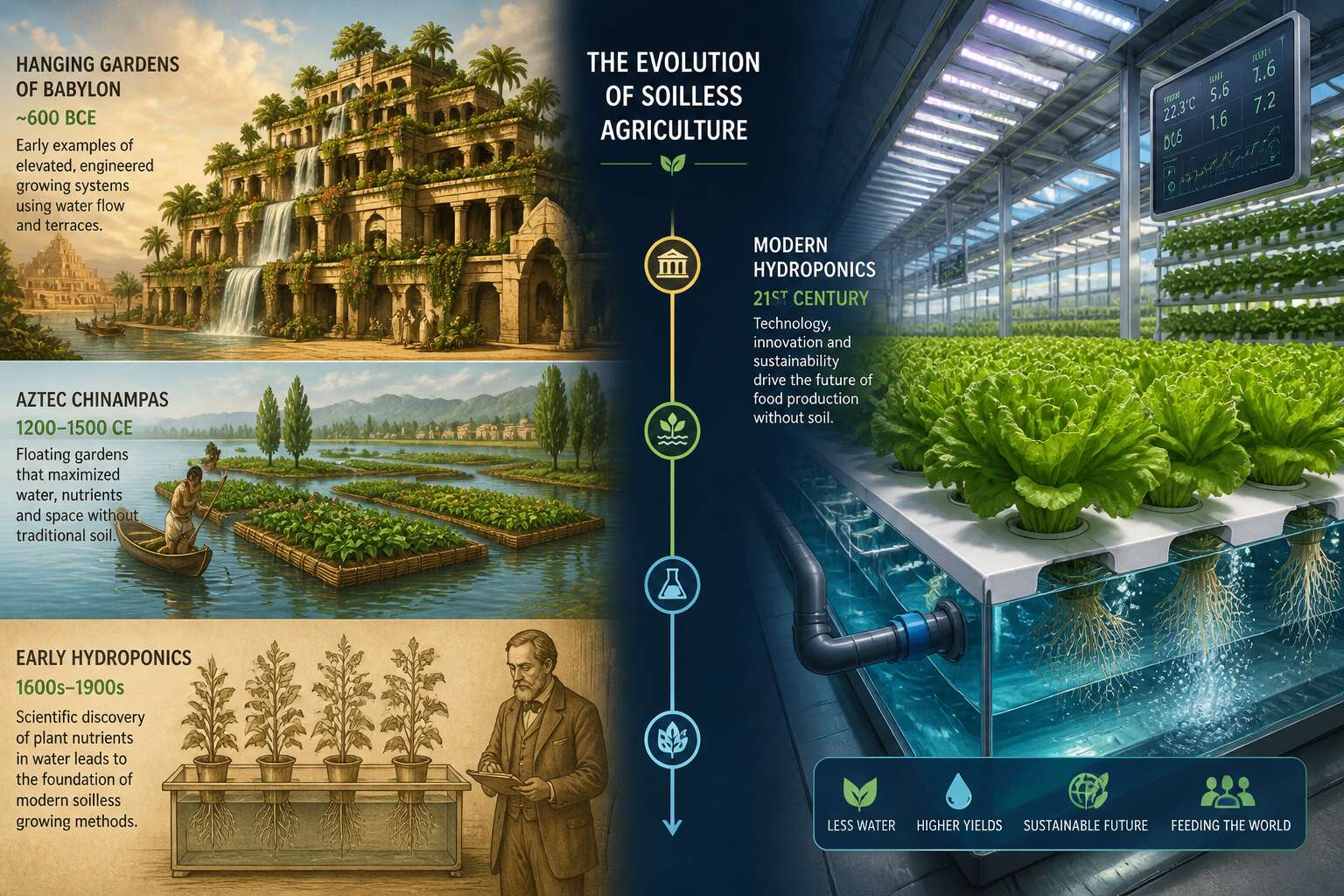
Tracing the Roots: Prehistoric and Ancient Soilless Cultivation
The Legendary Hanging Gardens of Babylon
Aztec Chinampas: Floating Farms of the Americas
Over 700,000 people once lived in Tenochtitlan, a city built on a lake. To feed them, the Aztecs transformed swampland into a grid of fertile islands. These were the chinampas, often called floating gardens, though they were anchored to the lakebed. Farmers wove reeds into a frame, then piled mud and decaying vegetation on top to create a rich growing medium. This process was a masterclass in soil management.
These raised beds were incredibly productive, yielding up to seven harvests per year. The constant supply of nutrient rich water from the canals meant that crops never suffered from drought. Crucially, this system bypassed traditional soil entirely, making it a key benchmark when exploring when was hydroponics made. The roots grew directly into the water filled channels, a technique that feels strikingly modern.
– The canals absorbed solar heat during the day and released it at night, protecting plants from frost.
– Willows planted at the corners secured the soil and provided wood for construction.
It seems the spirit of soilless farming was alive and thriving long before the term was coined. The Maya also employed a form of float farming using raised beds in shallow water, but the Aztec application was the most extensive. The question of antiquity is not a simple one, for these methods reveal a deep understanding of plant needs that predates any laboratory.
Early Chinese Wetland Agriculture Techniques
While the precise moment is lost to time, asking when was hydroponics made isn’t quite the right question. It’s more accurate to ask when humans first stumbled upon the principles. The answer takes us back thousands of years, long before the term “hydroponics” existed.
Our previous exploration of the Hanging Gardens and Aztec chinampas revealed that the core idea of growing plants without traditional soil is ancient. Yet, there is another thread in this rich tapestry, one that weaves through the rice paddies of ancient China. The earliest evidence of a soilless growing system can be traced back to the floating gardens of the Han Dynasty, around 200 AD. These weren’t just ponds with plants; they were sophisticated agricultural systems.
These early agriculturalists constructed rafts from bamboo and reeds. Over time, the organic material would break down, creating a rich, water-saturated root environment. The plants drew nutrients directly from the water enriched by decaying fish waste and organic matter. This method allowed for multiple harvests per year and reduced the impact of seasonal floods and droughts.
Here are some of the key innovations that marked the early days of this practice:
– The use of a solid, buoyant substrate like interwoven reeds for root anchorage.
– The creation of a nutrient-rich aquatic environment through the integration of fish and plant life.
– A focus on staple crops, primarily different varieties of rice, which thrived in these managed water systems.
This approach contrasts with the Aztec chinampas, which were anchored to the lakebed. The Chinese floating gardens were truly mobile and independent of the bottom soil. They were a direct method of growing in a nutrient solution, which is the very definition of hydroponics. So, when was hydroponics made in a commercial sense? That is a more modern story, beginning with researchers in the 1930s. But the practical application of the principles, the true genesis of the idea, didn’t start with a laboratory. It started on the calm waters of ancient lakes and rivers, where farmers observed that plants could thrive with their roots in water, not earth, driven purely by necessity and keen observation.
Archaeological Evidence from Ancient Egypt
Along the banks of the Nile, long before the term “hydroponics” entered our vocabulary, ancient Egyptians were quietly perfecting soilless cultivation. The question of when was hydroponics made often leads researchers to the lush reliefs and papyrus records dating back to 2000 BCE. These documents depict gardeners growing vegetables in shallow baskets woven from reeds, suspended over the river’s flowing water. The roots dangled freely, absorbing dissolved minerals carried by the annual flood. It was a practical response to a challenging climate, not a scientific experiment.
Archaeological digs near the Delta region have uncovered clay pots with perforated bottoms, designed to hold plants while their roots reached down into water reservoirs below. These rudimentary systems reveal a sophisticated understanding of plant nutrition. The Egyptians noticed that crops flourished when their roots accessed nutrient-rich water directly, even without soil contact.
– In tomb paintings, workers are shown tending beds of lettuce and onions in water-filled troughs.
– Seeds were germinated in sand, then transferred to floating mats of woven grass.
– The Nile’s silt, suspended in the water, provided essential minerals without the need for tilled earth.
These methods, refined over dynasties, demonstrate that when was hydroponics made is a question with a much deeper timeline than most assume. The Egyptians did not know the chemical composition of nutrients, but they understood the principle. Their application of soilless growing stands as one of the earliest documented uses of water culture. It was not until the 1930s that researchers in California formally named the practice “hydroponics,” but the groundwork was set along the Nile, thousands of years prior.
Scientific Awakening: The 17th to 19th Century Experiments
Francis Bacon and the Water Culture Theory
One hundred sixty years before the term “hydroponics” entered our vocabulary, Sir Francis Bacon planted seeds in water-soaked soil. His 1627 work, Sylva Sylvarum, contained a startling revelation. He discovered that plants grown in water without any soil could thrive. This contradicted the universal belief that soil was the sole source of plant nutrition.
Bacon’s conclusion was famously incorrect. He believed that pure water was the true food of all plants. He theorized that soil served merely as an anchor. However, his experiments gave birth to a scientific curiosity that had not existed for over a millennium. He initiated the first formal inquiry that asked the exact question about the roots of our modern practice.
The trail he blazed became a beacon for future researchers. During the following two centuries, scientists began to debate and test Bacon’s assertion. By 1699, John Woodward, an English naturalist, ran his own trials. He grew spearmint in different water solutions. He discovered that plants grown in water mixed with sediment were more robust than those in pure rainwater. This disproved the water-only theory and proved that soil contained essential minerals.
This period of botanical inquiry laid the groundwork for the actual invention. Researchers throughout Europe built on Woodward’s data. Their efforts chased the same answer to the question of when was hydroponics made:
– 1840: Justus von Liebig identified the essential chemicals for plant growth.
– 1859: Julius von Sachs successfully grew plants in nutrient solutions alone.
– 1868: Wilhelm Knop published a method for culturing plants in liquid solutions.
These were the first true soilless plant cultures. By the end of the 19th century, the science had moved from magical speculation to laboratory fact. The debate over soil’s role had ended, and the true answer to when was hydroponics made began to take its modern shape, though the term itself was still decades away.
Jan Baptist van Helmont’s Seminal Willow Experiment
In 1648, Jan Baptist van Helmont published a five-year experiment that quietly challenged a thousand year old assumption. He planted a willow sapling in a fixed weight of soil, watered it with nothing but rainwater, and waited. When he weighed the tree five years later, it had gained nearly 164 pounds. The soil had lost only two ounces!
Van Helmont concluded that water alone fed the tree. He was wrong about the mechanism, yet his empirical method was the breakthrough. He controlled his variables with unusual rigor:
- He measured the dry soil before and after.
- He used only rainwater, never compost.
- He covered the pot to block airborne debris.
His willow experiment did not answer when was hydroponics made. It proved that soil was not the source of a plant’s mass, redirecting European plant science toward water and dissolved minerals.
The question of when was hydroponics made remained unresolved for two more centuries. Van Helmont gave us a template of measurement and patience.
The Definitive Works of Sachs and Knop (Nutrient Solutions)
From the 17th century onward, the question of when was hydroponics made began to shift from philosophical musing to rigorous laboratory science. The intervening decades were marked by a systematic investigation into plant physiology. Researchers slowly discarded the idea of water as a direct food source, instead viewing it as a carrier for other essential elements. They sought to identify the specific minerals that allowed a seed to swell and a root to anchor.
The definitive answer to when was hydroponics made arrived with the combined efforts of German botanists Julius von Sachs and Wilhelm Knop in the 1860s. They developed a method to cultivate plants in a purely liquid medium, completely devoid of soil. Their innovation was a precise, water-based recipe containing measured doses of nitrogen, phosphorus, potassium, and trace elements. This was the first true nutrient solution, and it proved that a plant could complete its entire life cycle in controlled conditions.
Through a decade of meticulous work, they achieved several key breakthroughs:
– The creation of an optimal salt mixture for plant growth.
– The identification of essential macronutrients and micronutrients.
– A protocol for replenishing the solution to prevent nutrient depletion.
– The first scientific proof that roots do not require a solid substrate.
These experiments delivered a practical, workable system, not just a theory. They had effectively solved the ancient riddle of what feeds a plant. The exact manufacturing date might be debated, but the scientific foundation for modern growing was set on their laboratory benches. While the technology was primitive, the concept was complete. The true answer to when was hydroponics made is not a single year, but this remarkable period of chemical discovery.
Twentieth Century Milestones and Commercial Expansion
The 1930s Soviet Union and Arctic Agriculture
In the 1930s, the Soviet Union turned to hydroponics out of sheer necessity, not curiosity. Arctic mining towns had no arable land, yet they craved fresh food. Soviet agronomists devised soilless systems to grow vegetables in these brutal climates. The results were staggering. Greenhouses in places like Kirovsk produced cucumbers and tomatoes while snow buried the roofs. This era marked the first true commercial expansion of soilless farming.
When was hydroponics made viable on a large scale? The Soviet Arctic experiments answer that question. They refined nutrient solutions and adapted them to polar conditions. Common crops included:
- Cabbage
- Radishes
- Lettuce
- Onions
These efforts turned hydroponics into a tool for survival. I find it amusing that polar workers ate salads while the rest of the world considered this science fiction. The Soviets proved that location no longer dictated food production, a lesson that still shapes the industry today.
Wake Island and the WWII-Era Soilless Farms
The question of when was hydroponics made a commercially viable practice often points to a surprising theatre of war. While the Soviets were perfecting Arctic agriculture, another pivotal chapter was unfolding on a tiny Pacific island. Wake Island, a remote American outpost, became the site of a critical experiment in the early 1940s. The U.S. military needed to feed personnel stationed there, but importing fresh produce was logistically impossible. They constructed large-scale soilless farms, proving that this method could sustain entire communities in isolation.
This military application demonstrated the technique’s remarkable efficiency, free from the constraints of local soil quality or climate.
The success on Wake Island transformed the perception of the method from a laboratory curiosity into a serious food production system. The infrastructure required was substantial, but the payoff was a consistent, reliable yield of fresh vegetables. The techniques refined during this period, particularly in nutrient film management and substrate selection, laid the groundwork for future commercial ventures. By the mid-twentieth century, the focus shifted from survival to profit, and the first true commercial hydroponic operations began to emerge in the United States and Europe. This era answers the query of when was hydroponics made a viable industry, marking its transition from a necessity-driven experiment to a sophisticated agricultural sector.
Post-War Greenhouse Innovations in the 1950s-60s
By 1950, the question of when was hydroponics made commercially viable had a clear answer. Surplus military technology was recycled into civilian agriculture. The results were immediate and unmistakable!
The 1950s transformed greenhouse agriculture. Polyethylene film, developed during the war, became cheap enough to replace glass. Growers could now cover vast areas at a fraction of the cost. Hydroponic systems moved from simple troughs to sophisticated aggregate culture. Gravel, perlite, and sand became standard substrates, each studied for optimal performance.
Key breakthroughs included:
- Drip irrigation systems that delivered nutrient solutions directly to roots
- Sub-irrigation benches that dramatically reduced water waste
- Improved climate control for year-round production
Commercial operations multiplied across California and southern Europe. The industry moved beyond its wartime origins. When was hydroponics made a profitable pursuit? The answer lies in these post-war decades, where enterprise met horticultural science.
NASA’s Role in Pioneering Space-Based Hydroponics
The question of when was hydroponics made takes on a different hue when we look to the stars. By the 1980s, NASA had turned its gaze from the remnants of war to the frontier of space, and with that shift, the entire lexicon of soilless agriculture changed forever. Their research was not about profit margins; it was about survival in a vacuum where every gram of soil is a luxury no spacecraft can afford.
NASA’s protocols forced a radical simplification of the nutrient delivery process. They needed systems that were lightweight, self-regulating, and capable of operating in microgravity. The results of this work have a distinctly macabre poetry to them, as we learned to grow our food in environments that are utterly hostile to terrestrial life.
– Vertical aeroponic chambers that could staple crops to a wall of mist.
– Closed-loop water recycling that would make a desert hermit weep with envy.
– LED spectral tuning to mimic a sun that is millions of miles away.
These innovations answered the deeper question of when was hydroponics made truly functional. It was not in the greenhouses of California, but in the sterile, silent labs built for a journey to Mars. The knowledge bled back down to Earth, giving commercial farmers a stark new efficiency. The soil had been left behind, and in its place, we found a precise, unforgiving science.
The Oil Crisis and the Shift to Alternative Agriculture
Modern Hydroponics: The 21st Century Revolution and Beyond
The Rise of Vertical Farming Systems
The old methods feel almost quaint now, don’t they? Since the 1930s, the core question of when was hydroponics made has evolved far beyond simple sand and water setups. While historians can pinpoint when was hydroponics made as a practical agricultural tool, the modern era has completely redefined the scale and ambition of the practice. We are no longer just growing plants without soil; we are engineering entire ecosystems in vertical columns that scrape the sky.
This 21st-century revolution is driven by a convergence of crises: urban sprawl, climate volatility, and a global supply chain that snaps under pressure. The response has been the vertical farm. These are not your grandfather’s greenhouses. They are data-driven facilities where LED spectra are tuned to the nanosecond and nutrient delivery is precise to the milliliter.
The shift from horizontal fields to vertical towers is a radical rethinking of space. Consider the logistical advantages that have propelled this technology forward:
1. Yield Density: A single vertical footprint can produce yields equivalent to a field several hundred times its size.
2. Water Conservation: These systems often use up to 95% less water than traditional irrigation, recycling every drop through closed-loop circuits.
3. Location Independence: By situating farms inside city limits, the “food miles” shrink to zero, and produce arrives with a freshness that is impossible to replicate with cross-continental shipping.
4. Climate Resilience: Cabbages and tomatoes are no longer at the mercy of hailstorms or droughts; they grow in a controlled, sterile environment.
Although the question of when was hydroponics made is rooted in academic curiosity, the future is rooted in vertical integration. Allowing technology to eliminate the unpredictability of weather is the final frontier here. As energy costs continue to drop and AI-driven monitoring becomes more sophisticated, these urban towers will shift from a premium novelty to a staple of food security. The narrative has moved on from ancient ingenuity to modern necessity, and the growth trajectory shows no sign of stopping.
Integration of Aquaponics and Recirculating Systems
Aquaponics and recirculating systems have turned modern hydroponics into a closed-loop operation. Fish waste feeds plants, while plant roots purify water for fish. This symbiosis reduces external inputs dramatically.
When was hydroponics made a purely soil-free practice? Today, it is a biological partnership. Recirculating systems recapture up to 99% of water, a vital feature for drought-prone South Africa. These methods cut fertilizer costs and eliminate runoff.
- Nitrogen cycling happens naturally through bacteria
- Energy consumption drops with integrated pumps
The innovation has moved beyond mere technique into ecological engineering.
Advances in LED Lighting and Automated Nutrient Delivery
Horticulture has crossed a threshold where the question, when was hydroponics made, feels almost archaic. The practice no longer merely feeds plants; it converses with them. Modern systems utilize arrays of LED lighting that mimic the precise wavelengths of the sun, offering a spectrum tuned to the photosynthesis peaks of leafy greens. These lights hum with an efficiency that outpaces the sodium-vapor lamps of previous generations, reducing energy usage by nearly 60% while generating less heat. This is not a minor improvement; it is a recalibration of the environment itself.
Automated nutrient delivery provides a quiet intelligence to the greenhouse. Sensors read electrical conductivity and pH levels in a continuous stream, adjusting the solution mix on a minute-by-minute basis. The system understands the plant’s appetite before the grower does. In a country like South Africa, where water is a currency, these automated dosers prevent waste, ensuring every milliliter carries purpose.
– Microprocessor-controlled fertigation reduces human error.
– Real-time data analytics predict nutrient uptake curves.
– Automated pH balancing prevents root shock.
The synergy of these technologies means a tomato vine can sip a precise meal at dawn, then a different one by midday. When was hydroponics made a static science? It was never meant to be. The modern iteration is a dynamic loop, one where the questions we ask about water and light are answered by the plants themselves.
The Impact of Data Analytics and AI on Crop Yields
When was hydroponics made a practical reality? While the Hanging Gardens of Babylon and Aztec chinampas hinted at soil-less cultivation, the true genesis occurred in the 1930s. Dr. William Frederick Gericke of the University of California coined the term “hydroponics” and shocked the agricultural world by growing tomato vines over twenty feet tall in a simple water and nutrient solution. His work moved the concept from a laboratory curiosity to a viable farming technique.
Gericke’s initial experiments were crude, relying on static solutions that often starved roots of oxygen. The field truly accelerated after World War II, when researchers sought reliable methods to supply fresh produce to troops stationed on barren islands. This military necessity drove deeper investigation into nutrient film techniques and aggregate culture, but the systems remained labor-intensive and prone to disease.
The modern question is no longer when hydroponics was made practical, but what we can achieve with the intricate data now at our disposal. We have moved far beyond simply dissolving salts into water. In contemporary South African operations, facing severe water constraints, the focus is on precision and predictive analytics. Sensors monitor the electrical conductivity and pH levels in real time, but the true innovation lies in the software that interprets this data.
These algorithms can predict a plant’s metabolic demands hours before a visual deficiency appears. This shift is crucial for commercial viability. A system that merely measures is passive; a system that learns is transformative. By analyzing historical growth patterns and current environmental inputs, AI can automatically adjust the delivery of specific mineral ions such as calcium or potassium, ensuring that the plant receives exactly what it needs for the upcoming photoperiod.
This analytical approach dramatically reduces the margin for human error and waste. A farmer can no longer justify a blanket fertilizer schedule; the data dictates that a morning feed be rich in nitrogen for vegetative growth, while an afternoon feed might boost phosphorus to encourage root development. This is the true revolution: hydroponics is no longer a static method of growing, but a dynamic conversation between the grower, the plant, and the machine.
Climate Resilience and Urban Food Security
When was hydroponics made a cornerstone of modern agriculture? The historical timeline stretches back to the Hanging Gardens, but the real transformation began in the 1930s with Dr. Gericke’s dramatic demonstrations. Yet, the systems we see today, especially in water-stressed regions like South Africa, bear little resemblance to those early nutrient baths.
Contemporary hydroponic farms are precise, data-driven ecosystems. Instead of static solutions, growers now deploy closed-loop systems where every drop is filtered and recirculated. This engineering shift is crucial; in a country where rainfall is unpredictable, these units can reduce water usage by up to 90% compared to traditional soil farming, all while producing higher yields per square meter.
These modern installations offer several distinct advantages for local growers:
– Climate resilience: Operations continue unabated through heatwaves or droughts, sheltered from erratic weather.
– Rapid nutrient control: The growing environment can be adjusted in real time, which accelerates growth cycles significantly.
– Spatial efficiency: Vertical stacking means that even small urban plots can produce commercial quantities of leafy greens.
The intelligence driving these systems is what truly separates them from their predecessors. Algorithms now parse sensor data to predict plant stress hours before it becomes visible. For the South African farmer, this means a morning feed can be automatically enriched with potassium if the system anticipates a hot afternoon, ensuring the crop never falters. That is the real answer to the question of what modern hydroponics has become: not a historical footnote, but a living, responsive technology that is redefining food security in arid climates.
Emerging Trends for the Next Decade
When was hydroponics made? The answer depends on how you define the practice, but the modern era began in the 1930s. That decade moved the technique from laboratory curiosity to commercial reality.
Today’s systems are far removed from those early experiments. A grower in the Western Cape can now monitor nutrient levels from a smartphone, with sensors adjusting the feed every few minutes. This responsiveness is the true revolution.
The next ten years will push this technology further.
– Resource efficiency: Expect systems that recycle 98% of water while using new filtration methods to prevent pathogen buildup.
– Energy autonomy: Solar arrays and battery storage will allow off-grid operation, a critical step for remote South African communities.
– AI integration: Machine learning will soon identify micronutrient deficiencies through leaf imaging, long before the human eye can spot a problem.
The key question of when hydroponics was made has shifted from historical curiosity to practical urgency. As municipal water supplies tighten and heatwaves become routine, the closed-loop reliability of these systems becomes a matter of food security.
The advances in automation will define the future. New sensors will track plant metabolism in real time, altering the delivery of nutrients based on the plant’s natural circadian rhythm rather than a fixed schedule. This level of precision, combined with predictive disease modeling, will reduce crop losses dramatically. Anyone entering this field now should focus on the data layer, not just the plumbing.

0 Comments